Ampol’s chief executive Matt Halliday spent most of a recent interview on ABC’s That’s Business with Alan Kohler talking about oil, not electrons: the Iran war, the Strait of Hormuz, refinery margins, fuel security payments. But about twenty minutes in, Kohler turned the conversation to EV charging, and Halliday gave one of the more candid public accounts we’ve heard from an Australian fuel major on how the economics actually work.
Here’s what stood out.
The network is growing, but off a small base
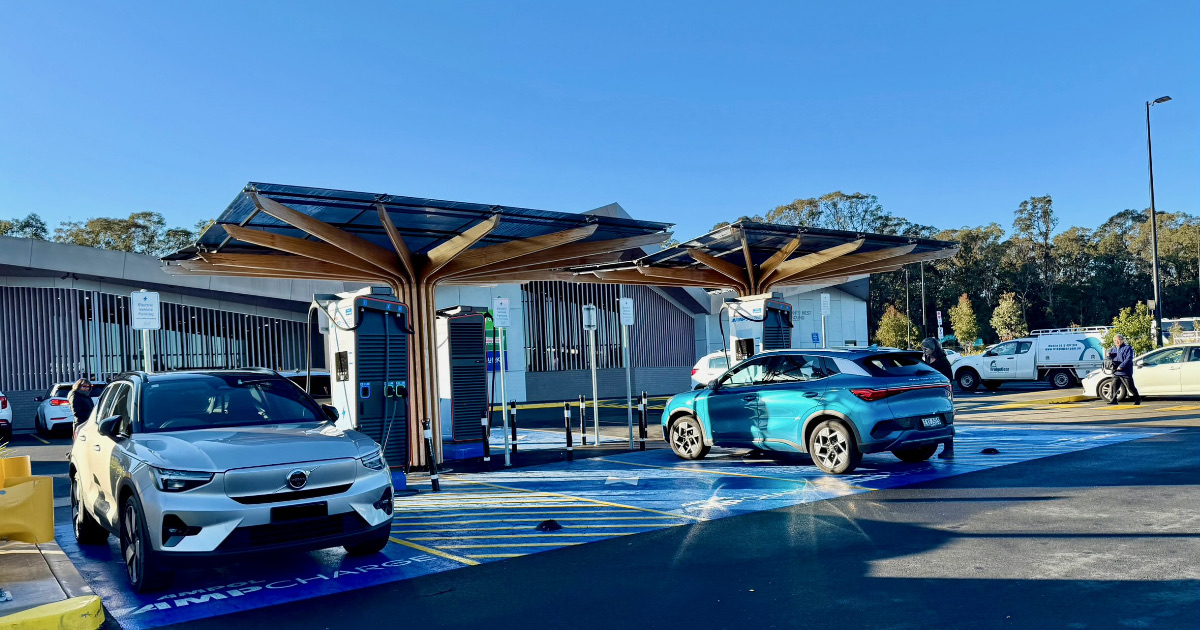
Ampol had 354 charging bays in Australia as of the interview, split across its own petrol forecourts and shopping centre partnerships. Roll forward to the net zero part of the conversation and Halliday cited “well over 550 bays” across Australia and New Zealand combined, which gives a sense of how fast the rollout is moving even within a single interview.
That’s still a fraction of Ampol’s forecourt footprint. The network comparison in our charging apps guide puts AmpCharge at 73 sites and 208 sockets, often a single 75 kWh charger per site. Halliday’s answer to why coverage stays thin: location matters more than count. Ampol tracks postcode-level data on where EVs are turning up and what journeys look like, and won’t put a fast charger everywhere it has a bowser. Grid connectivity rules some sites out entirely, and some regions won’t see EV uptake reach viable levels for years.
Most of the cost isn’t the charger
Halliday’s clearest number: when Ampol rolls out a fast charging site, over three quarters of the investment goes into electrical connectivity and grid augmentation, not the charger hardware itself. That matches what we’ve heard from planning-guide conversations with commercial charging operators: the charger is the easy part, and the queue for a grid connection is what actually paces a rollout.
It also explains why Halliday expects funding gaps in regional and congested areas specifically, rather than a blanket subsidy call. Where the electrical connection is expensive and demand is thin, the business case doesn’t stack up without help.
Margins are lower, but customers charge more often
Asked directly whether EV drivers make Ampol less money than petrol drivers, Halliday didn’t dodge it: margins on charging are lower than on fuel. The offset is frequency. He pointed to AEMO data suggesting public charging accounts for roughly 30% of all EV charging in Australia, with the rest happening at home, and argued that as more people rely on public charging as their only option, not just their road-trip backup, the volume starts to make the margin work.
That’s the same “no-home-charging customer” segment we flagged in our public networks vs home charging comparison: renters, apartment dwellers, and anyone in a grid-constrained area where a home charger isn’t realistic. Halliday named exactly this group as the addressable market Ampol is building for, alongside fleet customers replicating today’s fuel-card model with an AmpCharge card instead.
Free charging isn’t coming, but dynamic pricing might
Kohler asked whether shopping centres might subsidise free charging to get shoppers through the door, the way some retailers treat parking. Halliday was blunt: he doesn’t see that happening at scale given the price of electricity. What he does expect is more dynamic, time-of-day pricing that reflects when power is actually cheap, which in practice means the middle of the day when rooftop solar is flooding the grid. It’s a slower version of the free and near-free charging windows already showing up on the home-charging side.
Reliability is the metric Ampol is chasing
One figure worth remembering: Ampol reported over 99% uptime in June, meaning a driver who turns up to a charger finds it working 99% of the time. Halliday framed this as the real battleground, ahead of speed or price, because charger reliability has been a global weak point for the industry. It’s a fair point. Our own idle and congestion fee coverage and the Central Coast trip notes on this blog have both run into out-of-service chargers at AmpCharge sites, so a 99% claim is worth tracking against real-world reports over the next few months rather than taking at face value.
Charging speed: the near-term promise
Today’s typical AmpCharge session takes 15 to 20 minutes to go from 20% to 80%, depending on the vehicle. Halliday expects that to fall below 10 minutes within five years as battery and charging technology improves. That’s a vehicle-side claim more than a charger-side one; Ampol’s fastest current sites already hit up to 335 kW, so it’s the cars, not the plugs, that need to catch up.
Why an oil company CEO is thinking this far ahead
The context for all of this is a refining business under real pressure. Halliday confirmed EV and hybrid uptake is already forcing Ampol to reconsider what its Lytton refinery produces: less petrol, more diesel and jet fuel, because petrol demand falls first as EVs take a growing share of new car sales (Halliday cited figures in the 15 to 18% range for the most recent quarter, up from around 8% a year earlier). Rebalancing that output mix is expensive, and it’s part of the billions in investment Ampol is negotiating with government to keep Lytton open long-term.
Put together, the interview reads less like an oil company dabbling in EVs and more like a fuel retailer positioning for the point where petrol stops being the main game. The charging numbers Halliday gave are still small next to Ampol’s forecourt fuel business. But the framing, treating charging cards and postcode-level demand data the same way it treats its fuel network today, suggests Ampol is building toward the scale it eventually expects to need.
Source: That’s Business with Alan Kohler, ABC, interview with Ampol CEO Matt Halliday.