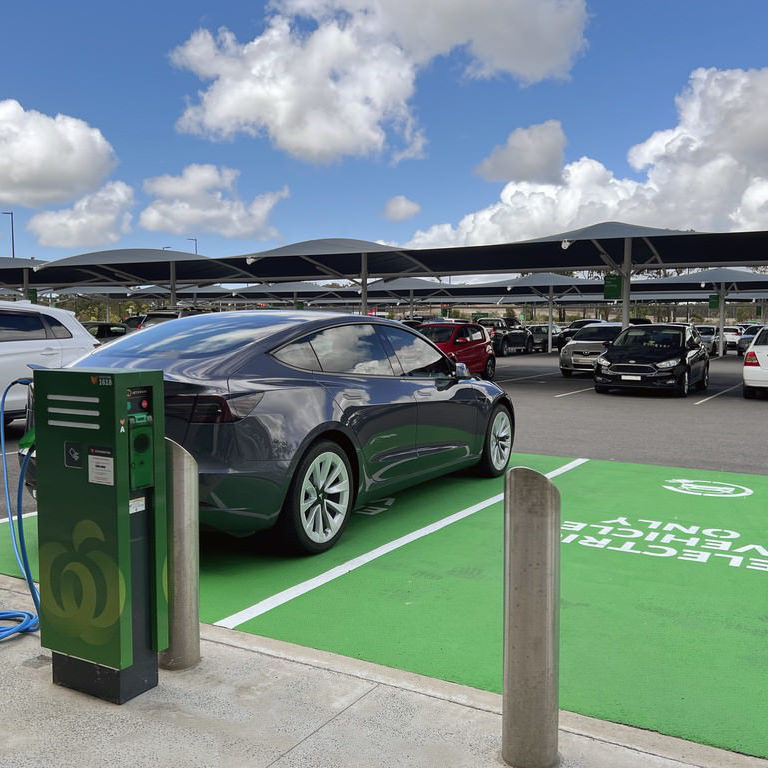
Over Easter 2026, social media lit up with photos of queues at EV charging stations along major Australian highways. The Coolac NSW Tesla Supercharger (a 12-bay site on the Hume Highway about 15 kilometres north of Gundagai) became the poster child for a narrative that goes like this: the charging network isn’t ready, EVs are stranded, the whole thing is a disaster.
The congestion was real. But the narrative deserves a closer look.
What actually happened at Coolac
Carloop, a platform that tracks per-minute occupancy across ten Australian charging networks, published data on the Coolac site around the same time. The numbers are instructive.
Good Friday: the station ran at over 95% occupancy for roughly eight hours, from 10am to 6pm. Easter Monday: same story, another eight hours. Both periods were genuinely difficult — and worse, every other DC fast charger within 100 kilometres on the Hume Highway was simultaneously congested. There was nowhere to redirect.
The social media posts weren’t wrong. On those two days, on Australia’s busiest interstate, EV drivers faced real queues with no viable alternatives.
But here’s the full picture
Carloop’s data covers the Coolac site from late January 2026 to mid-April. Over that full period, the station ran at 90% or higher occupancy for just 0.65% of the time. Its average occupancy was 10.3%.
That is a congested site for two days of public holidays. For the other 98-odd days in the sample, it was fine.
Compare that to a 12-stall urban Supercharger in Box Hill, Victoria. Average occupancy: 30% — three times higher than Coolac. Congestion above 90%: 0.4%. Urban drivers top up opportunistically and leave when a site looks busy. Highway drivers on a 600km road trip don’t have that option.
Understanding the hardware
The Coolac site uses Tesla’s V4 architecture, which is worth understanding. Each 250kW power cabinet serves three or four charging stalls. At full occupancy, four vehicles sharing one cabinet each receive a maximum of 62.5kW, meaningfully slower than the headline spec. The station’s total capacity is 750kW across three cabinets and twelve stalls.
Tesla addresses this with congestion pricing: $0.50 per minute once your battery exceeds 80% state of charge and the site is busy. The fee also accrues if you’re plugged in but have stopped charging, discouraging the habit of topping to 100% while others wait.
If the pricing does its job, the site cycles through roughly 13 vehicles per hour, each getting enough energy for about 300 kilometres of highway driving. That is actually a reasonable throughput number. The problem is the queue that forms when demand spikes past even that.
The comparison that matters
Here is the number that should make charging operators uncomfortable: the smallest petrol station in the Coolac area has enough bowsers to service more than four times as many vehicles per hour as the Coolac Supercharger at peak. Even with congestion pricing maximising throughput, the infrastructure gap is significant.
There are at least nine petrol stations in that 100km stretch of highway. EV drivers had seven charger sites, and on Good Friday, they were all full at the same time.
What the data actually says
This is not an argument against EVs. It is an argument for building more charging infrastructure on high-traffic routes, faster.
The commercial case is clearly there. As per Carloop, the Coolac site has generated an estimated $73,863 in charging revenue since January 2026, and that figure will only grow as EV adoption — now past 15% of new light vehicle sales — continues climbing. The demand exists. The revenue exists. The constraint is physical infrastructure.
The solution is straightforward if unglamorous: more sites, more stalls per site, higher-power cabinets on major highway corridors. The Hume Highway alone likely needs three to four times its current charging capacity to handle peak holiday travel without queuing.
In the meantime: if you’re heading south on a long weekend, there is a six-stall Tesla Supercharger in Gundagai, ten kilometres from Coolac. Leave a gap between the two in your plan, charge to 80% and move on.
The Easter queues were a preview of what happens when EV adoption outpaces infrastructure investment. The answer is not to slow the adoption.