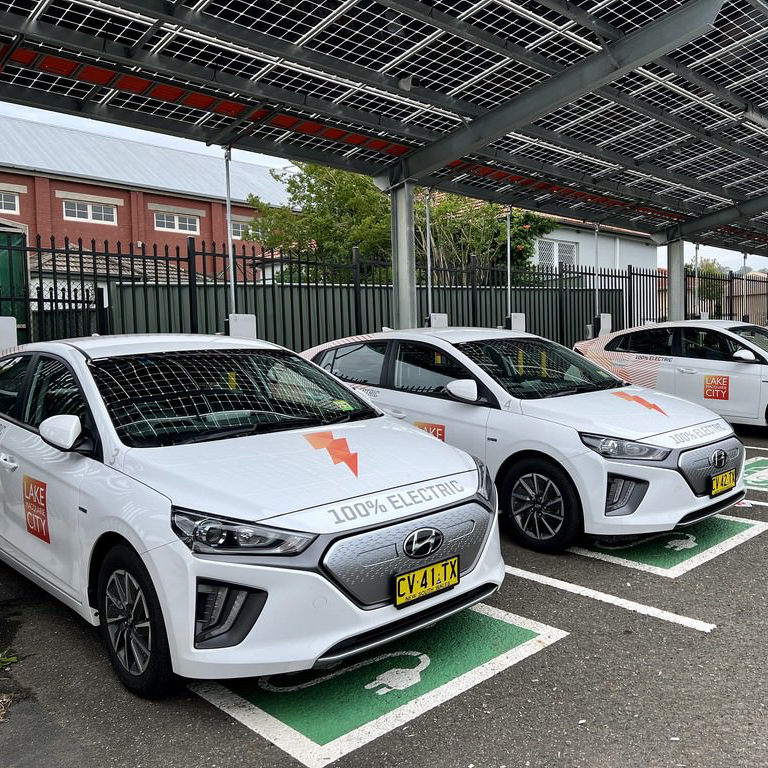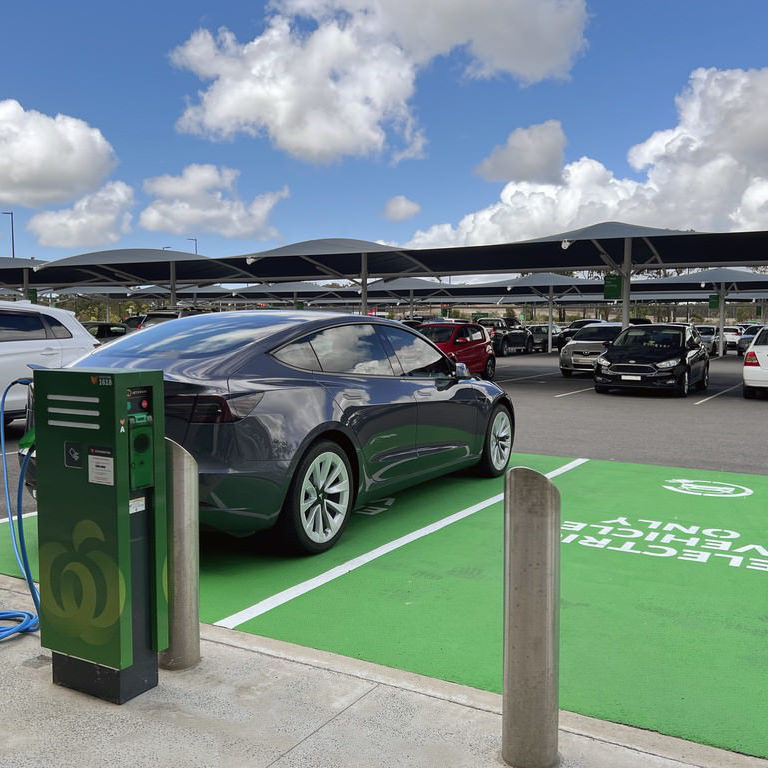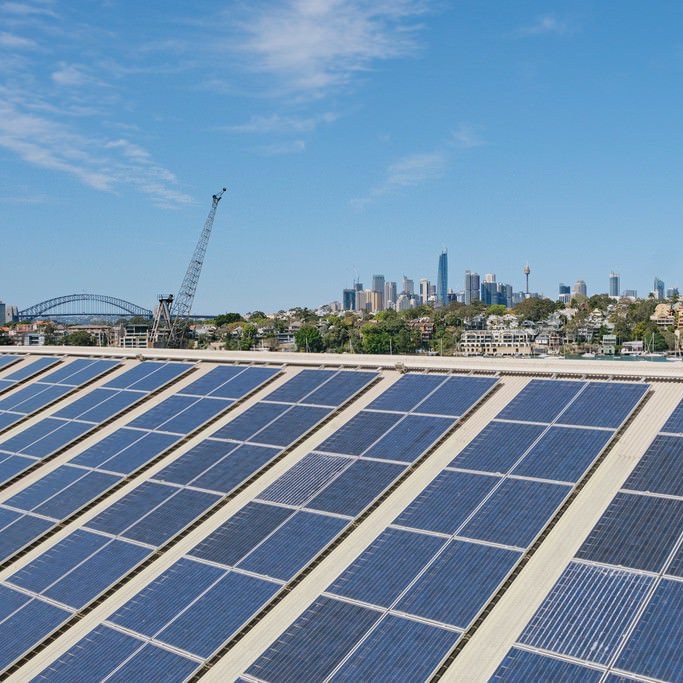
Stand in any large car park at noon on a sunny day and you’ll notice two things: an expansive flat surface baking in the sun, and a lot of hot, uncomfortable cars.
All that energy hits the tarmac and bounces back as heat. None of it gets captured. No one is cooled. Nothing is charged. It’s just waste, sitting on land that’s already been paved over and written off.
That’s the starting absurdity. Car parks cover enormous areas (shopping centres, offices, hospitals, stadiums) in some of the most solar-productive parts of the country. They face the sky all day. And increasingly, they’re filling up with large batteries on wheels.
Three European car parks that proved the model
Before getting into the argument, it helps to know this isn’t a theory. Three large-scale solar carports in Europe are already running, and their numbers are worth sitting with.
- Pairi Daiza, Belgium a zoo and wildlife park with roughly 200,000 m² of car park now covered by 93,000 solar panels producing approximately 40 MW of generating capacity, around 39,900 MWh per year. Surplus production feeds EV charging and exports to the grid.
- Biddinghuizen, Netherlands a festival car park covering around 350,000 m² and 15,000 spaces, with ~37.7 MWp installed capacity generating roughly 35 GWh per year. The interesting detail: the panels generate continuously whether cars are present or not. The venue doesn't even need to be running.
- Disneyland Paris, France 11,200 spaces, 17 MW, ~36 GWh per year. That covers around 17% of the entire resort's electricity demand. From a car park.
These are not prototypes. They are operational infrastructure at tens of megawatts each.
It’s already happening in Australia
Australia doesn’t need to look to Europe for proof. There are at least eleven operational solar carport installations across the country right now at shopping centres, universities, a leagues club and a produce market.
The largest is Elizabeth City Centre in Adelaide, where Vicinity Centres has installed 3.2 MW of solar carport capacity as part of a 5.9 MW total system, the largest single solar installation on any Australian retail property. Around 1,400 parking spaces are shaded, four EV charging stations are integrated, and the site generates roughly 11.5 GWh per year shared with the adjacent Castle Plaza development.
Castle Plaza itself has 2,244 kW of carport solar, a 548 kWh battery storage trial, and its own EV chargers — deployed using semi-flexible panels on a large-span mounting system.
Up in Townsville, Willows Shopping Centre has 1.5 MW across 500 shaded spaces, with 4,800 panels managing high daytime loads in one of Australia’s most demanding solar climates.
Sydney Markets in Flemington has 640 kW covering around 350 spaces, saving an estimated 936 tonnes of CO₂ per year and reportedly hundreds of thousands of dollars off the electricity bill annually.
And closer to (my) home on the Central Coast: Deepwater Plaza in Woy Woy completed a 253.4 kW solar carport in November 2020, 768 panels over 100 spaces in the Coles car park off Charlton Street. The centre was sold in 2023 for A$111 million at a 6.5% cap rate. The solar installation was part of a broader value-add upgrade that reduced operating costs and improved the asset’s appeal to institutional buyers. It’s the kind of local example that sits alongside the broader Central Coast charging gap and the later Central Coast new chargers rollout.
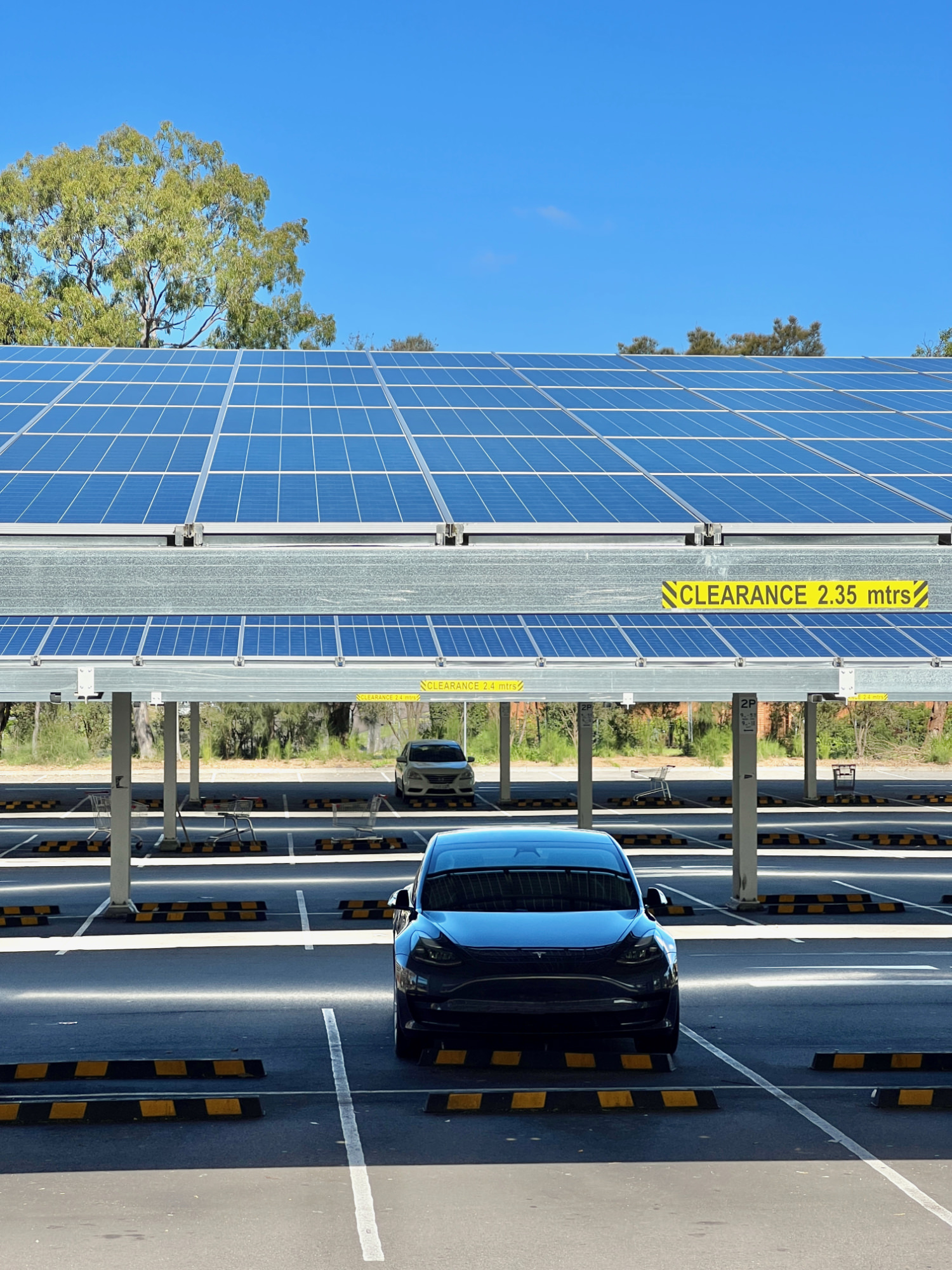
The full picture across Australia:
| Site | Capacity | Annual generation | Notes |
|---|---|---|---|
| Elizabeth City Centre, SA | 3.2 MW carport / 5.9 MW total | 11.5 GWh (shared) | Largest AU retail solar; ~1,400 spaces; EV chargers |
| Castle Plaza, SA | 2,244 kW | 11.5 GWh (shared) | Battery trial; EV chargers; semi-flexible panels |
| Willows Shopping Centre, QLD | 1.5 MW | 2,500 MWh | 500 spaces; 4,800 panels |
| Wagga Wagga Solar Carport, NSW | 818 kW | 1,213 MWh | 1,209 t CO₂/yr saved |
| Barwon Prison, VIC | 773 kW | 1,070 MWh | Fast-install steel construction |
| Monash University, VIC | 723 kW | - | Education sector |
| Sydney Markets, NSW | 640 kW | - | 350 spaces; 936 t CO₂/yr |
| West Illawarra Leagues Club, NSW | 365 kW carport / 590 kW total | - | 120 spaces; 4× 22 kW EV chargers |
| Deepwater Plaza, Woy Woy, NSW | 253.4 kW | 253 MWh | 100 spaces; sold 2023 for $111M |
| Northam Boulevard, WA | - | 1,871 MWh | 40% of centre’s energy demand |
| PA Central, Brisbane, QLD | 100 kW | - | 30–40% energy cost reduction |
The West Illawarra Leagues Club example is worth a closer look for anyone thinking about installation logistics. The club used Canyon Solar prefabricated pods: 36 individual units, 7.5 m × 2.6 m each, with bifacial panels factory-fitted. Combined with an existing 225 kW rooftop system, the 590 kW total covers around 30% of the club’s electricity. The prefab approach brought the full installation in under a month, roughly three times faster than a traditional build, which matters when you’re closing parking bays for construction.
Tesla is doing it at Superchargers too
Solar canopies aren’t only turning up at shopping centres. Tesla has installed solar canopies at two NSW Supercharger stations, co-funded by the NSW Government, with open-access conditions requiring both sites to serve all EV brands — part of the same broader charging build-out covered in NSW’s 300 new planned chargers.
Raymond Terrace has 70 kW — the first Tesla solar canopy in Australia. New Italy has 80 kW across 12 bays, including a pull-through bay for towing, making it the largest Tesla solar canopy in the country so far.
Planning complexity has slowed further rollout — Coolac had both a solar canopy and a Megapack planned, but both were dropped. Queensland sites at Tully and Cairns are under consideration.
Why carports beat remote solar farms for urban energy
Large-scale centralised solar works. The Midong plant in Xinjiang runs at 3.5 GW and supplies roughly two million homes. But it requires dedicated land, and the energy has to travel long distances before it reaches someone who can use it, with losses at every step.
Solar carports invert this logic. Generation happens where the demand already is. Lower transmission losses. Vehicles are shaded in summer, which reduces the energy needed for cabin pre-cooling before you get in. And every carport becomes a natural EV charging point without separate infrastructure.
The timing fits well too. Midday solar peaks when offices, shopping centres, and stadiums are already full. Instead of exporting surplus solar to the grid and then importing grid electricity to charge parked EVs — two round-trips, two sets of losses — the carport closes the loop. Solar goes straight into the car in the bay below.
This is the same logic behind smart home charging: the best time to charge an EV is midday, not 6pm when the grid is under pressure. A solar carport makes midday the default, not a scheduling exercise.
The financial case in Australia
Self-consumption is what makes the numbers work. NSW grid electricity exceeds 30c/kWh. Feed-in tariffs pay 5–10c/kWh. Every kilowatt-hour used on-site is worth three to six times more than every kilowatt-hour exported, so systems sized for self-consumption rather than export return far better.
Typical payback windows for Australian commercial solar carports:
| System size | Annual savings | Payback |
|---|---|---|
| 30 kW (small retail/office) | A$9,000–$10,000 | 3.5–4.5 years |
| 50 kW (medium commercial) | A$15,000–$18,000 | 3–4 years |
| 100 kW+ (large-scale) | A$30,000–$35,000 | 3–6 years |
At institutional scale, Vicinity Centres projects roughly 12% IRR across its ~A$73 million solar carport portfolio.
Two federal incentive schemes apply, both running until 2030. Systems under 100 kW qualify for Small-scale Technology Certificates (STCs), which provide approximately 30% off the installed cost as an upfront discount. Systems above 100 kW generate Large-scale Generation Certificates (LGCs), roughly A$25 per MWh generated, as ongoing tradeable income. A 500 kW system generating ~700 MWh/year adds around A$17,500/year in LGC income on top of the self-consumption savings.
There’s also a climate angle that reframes the conversation for property managers. Adelaide’s Elizabeth City Centre has recorded 45°C peak temperatures; Castle Plaza, 44°C. A solar canopy shades vehicles during those peaks, reducing cabin temperature and the air-conditioning load when drivers return. In hail-prone parts of eastern Australia, a rigid canopy is also physical protection against storm damage claims. That shifts the budget conversation from “energy project” to “asset protection infrastructure.”
The V2G angle
There’s a longer-term dimension. As bidirectional charging spreads, parked EVs won’t only be consuming power, they’ll be able to push it back to the grid during demand spikes. A car park with several hundred V2G-capable EVs becomes a distributed grid battery that charges from the canopy above and discharges when the network needs it.
Australia’s grid doesn’t yet support V2G at residential or commercial scale, the bidirectional infrastructure, metering standards, and regulatory framework are still catching up. But the hardware is coming, and the car parks will already be there. A solar canopy built today is V2G-ready infrastructure for when the grid is ready for it.
The most advanced commercial installations are already moving in this direction. Melbourne Airport operates as a GreenPower-approved provider, supplying on-site solar directly to tenants — a car park functioning as a microgrid utility. Castle Plaza’s battery trial points the same way.
Why it’s still not the default
The technology works. The economics stack up. Deployment is still the exception rather than the rule, and the reasons aren’t technical.
Ownership fragmentation. The car park owner, the canopy installer, the energy metering operator, and the electricity retailer are often different parties with different incentives.
Property owner resistance. Retail operators don’t want to become energy managers. It’s outside their core business, and the upfront capital commitment is real even with STCs reducing the cost. That hesitation is exactly why the NSW Fast Chargers host-site program matters: it lowers the barrier for landowners willing to make space available without becoming charging operators themselves.
Utility friction. Distributed generation on existing commercial property competes with centralised utility revenue. Grid connection approvals don’t always move quickly.
Structural complexity. Tensile fabric shade structures, a common sight in Australian commercial car parks, require specialist re-engineering before solar can be added, as rigid PV panels change the load and wind dynamics. A solar-ready canopy designed from scratch costs less than retrofitting an existing shade structure.
This last barrier is slowly inverting. Solar carports directly improve NABERS and Green Star environmental ratings, which increasingly govern access to institutional funding and high-tier tenants. A car park without a solar canopy is now an active drag on a property’s environmental score. The Deepwater Plaza sale shows how a solar installation makes for a more attractive story for institutional buyers.
France didn’t wait for the market
In 2023, France legislated: any car park with 80 or more spaces must install solar canopies covering at least 50% of the area. Both existing and new sites. Not a tax break, not a grant, not a target — a requirement.
The estimated national impact is 7–11 GW of new generating capacity.
By treating solar canopies like fire exits, a standard condition of operating a large parking facility, France is on track to add capacity equivalent to several large power stations, from surfaces that already exist. The voluntary path didn’t produce that. The Disneyland Paris car park existed for decades before the solar went on in 2023.
Australia has no equivalent law. Every major shopping centre, hospital campus, office tower and stadium car park is sitting in the sun generating nothing. The tools exist, the incentives exist until 2030, and eleven operational sites across the country prove the model works locally.
Related: Strategic planning guide for commercial EV charging infrastructure · NSW Fast Chargers · NSW’s 300 new planned chargers
References:
-
Solar-Ready Carports in Australia: The Future of Sustainable Vehicle Protection,
-
Future-Proofing: Solar EV Car Park Canopies in AU - Versatile Structures,
-
Commercial Solar Carports for Businesses - Melbourne - Energis,
-
The best solar carport structures for homeowners & businesses 2026 - Nova Mounting,
-
Commercial Solar Carports | Large-Scale Design, Supply & Installation - Mass Energy,
-
Commercial Solar in 2025: ROI Analysis for Business Leaders - Energy Action,
-
Australian Federal Government Solar Rebates & Incentives: Ultimate Guide,
-
The ROI of Commercial Solar for Australian Businesses: What You Need to Know,
-
Maximising Your Commercial Solar ROI: A Practical Guide for Businesses,
-
Commercial Solar ROI in Sydney: 30kW, 50kW & 100kW Systems Explained,
-
Deepwater Plaza sold for $111 million, completing $284.1 million in disposals by Dexus,
-
Australia’s largest car park solar program completed in SA - Vicinity Centres,
-
Vicinity completes Australia’s largest solar car park installation,
-
Australia’s largest solar panel installation - Charter Hall,
-
CQR Annual Report 2024 - Charter Hall Retail REIT (ASX:CQR) - Listcorp.,
-
Optimising peak demand and supporting grid stability through batteries | Property News,
-
Impact of the Glare effect on the airport functionality - Arka360,
-
How to Choose the Most Cost-Effective Solar Carport? 2025 Investor’s Guide - WANHOS,
-
Developing a Successful Commercial Solar Project - Spinifex Energy,