- 13.1% EV* share of new-car sales, 2025 (up from 9.6%)
- 454k+ EVs on Australian roads*, end 2025
- 93% of EV owners can charge at home
- 70–85% of charging is done at home
- 1,310+ public DC fast-charge sites nationally
- 4.3m households with rooftop solar
01 / The Cost Gap
Bottom line up front
For the ~93% of Australian EV owners who can charge at home, this isn’t a fair fight. Home charging on a dedicated EV tariff costs roughly 4.5–8c/kWh (and near-zero with rooftop solar), versus 48–99c/kWh at a public DC fast charger. That 6–20x cost gap means the two models are mostly complementary, not competitive: home charging is the default that delivers ~70–85% of all energy, while public networks own the journeys home charging can’t — road trips and the no-driveway minority.
The real strategic contest is less “public vs home” and more who owns the EV customer: fuel majors and motoring clubs building charging networks, versus electricity retailers turning the home, and soon the car battery itself, into a managed grid asset.
The cost gap between home charging and a public DC fast charger
02 / Head to Head
The core comparison
| Dimension | 🔌 Public charging networks | 🏠 Home charging (via energy retailers) |
|---|---|---|
| Representative players | Tesla Supercharger, Chargefox, Evie, NRMA, bp pulse, Ampol AmpCharge, JOLT | AGL, Origin, EnergyAustralia, Amber, OVO, GloBird, Red Energy |
| Energy price | ~48–99c/kWh DC fast (Tesla ~48c member; casual 59–75c; remote up to 99c). JOLT: first 7 kWh/day free | 4.5–8c/kWh on dedicated EV windows; ~0c with solar; ~29–32c if on a standard flat rate |
| Speed | 25–350+ kW DC → 10–60 min | 2–7 kW (single-phase) to 22 kW (3-phase) → overnight “wake up full” |
| Upfront cost to driver | None (pay-per-use); optional membership ($9.99/mo Tesla non-owner; club fees) | Wallbox + install ~$1,000–2,500; needs off-street parking + suitable switchboard |
| Convenience | Essential for travel/top-ups, but ~5–13% can be offline; queues at peak | Zero detour, plug in at home; the default for ~70–85% of energy delivered |
| Best-fit use cases | Long-distance/road trips; renters & apartment dwellers; fleets; emergency top-up | Daily commuting; overnight; solar self-consumption; anyone with a driveway |
| Revenue model | Pay-per-kWh + subscriptions/idle fees; forecourt convenience; ads (JOLT); club loyalty | Electricity margin + customer retention; VPP/demand response; future V2G value-stacking |
| Grid/smart angle | Site-level load management; some ToU pricing; battery-buffered remote sites | Smart scheduling, “solar soak”, VPP, emerging V2G — turns the EV into a grid/home asset |
| Ownership backdrop | Fuel majors (Ampol, bp), motoring clubs (Chargefox, NRMA), Tesla, infra investors (Evie) | Big-3 gentailers (AGL, Origin, EnergyAustralia) + tech-led challengers (Amber, OVO, GloBird) |
03 / Market context
Why the structure looks this way
- Adoption is broadening, not exploding. Combined EVs hit 13.1% of new-car sales in 2025 (up from 9.6% in 2024), with a December 2025 monthly peak of 16.7%. But the growth is increasingly PHEV-led (+131% in 2025) while BEV share crept up only ~1 percentage point. Total fleet: 454,000+ vehicles (Electric Vehicle Council, Jan 2026).
- Home is overwhelmingly where charging happens. ~93% of current EV owners can charge at home, and ~70–85% do most of their charging there (Evenergi/AER; EVC/ITLS 2025). Early adopters skew toward detached homes with driveways — and ~80% of home-chargers also have rooftop solar, making their marginal charging cost close to zero.
- The “no driveway” segment is the structural growth engine for public charging. ~6 million Australians live in strata; an estimated 25,000 EV owners already have no off-street parking, growing ~1,000/month. As EVs move from early adopters to the mainstream, this renter/apartment cohort grows, and they can’t access cheap home tariffs.
- Public infrastructure is scaling but patchy. 1,310+ DC fast-charge sites and 3,436+ DC plugs, growing ~8.5% per quarter. Reliability is the persistent weak point: up to ~13% of public chargers can be unavailable at any time, dogged by first-generation Tritium hardware failures. Tesla is the outlier at ~99.5% uptime.
04 / The Public Networks
A crowded field, consolidating
A crowded, capital-hungry field consolidating around a few models:
| Network | Owner & model | Footprint (2025–26) | Speeds | Indicative price |
|---|---|---|---|---|
| Tesla Supercharger | Tesla; vertically integrated | 152 sites / 817 plugs; ~72% open to non-Tesla | 125–250 kW | ~48c/kWh median (member); up to 85c non-member peak; $9.99/mo non-Tesla membership; ~99.5% uptime |
| Chargefox | Motoring clubs (NRMA, RACV, RACQ, RAA, RAC, RACT) | ~400+ DC locations (largest) | 50–350 kW | ~45–68c/kWh; club members save 10–20c |
| Evie Networks | StB Capital (Trevor St Baker) + RACQ | 300+ locations, 1,000+ plugs | 50–400 kW | 49c member / 59c non-member; up to 75c ultra-fast |
| NRMA Electric | NRMA (mutual); $78.6m federal co-funded | 100+ highway locations, national | 50–150 kW+ | 69c standard; 75–99c remote; 5c member discount |
| bp pulse | bp plc; forecourt | 220+ charge points | 75 kW (upgradeable to 150) | ToU, app-only (~50–60c); AGL customers −6c |
| Ampol AmpCharge | Ampol; forecourt | 73 sites / 208 sockets | 50–180 kW | ~75c/kWh flat |
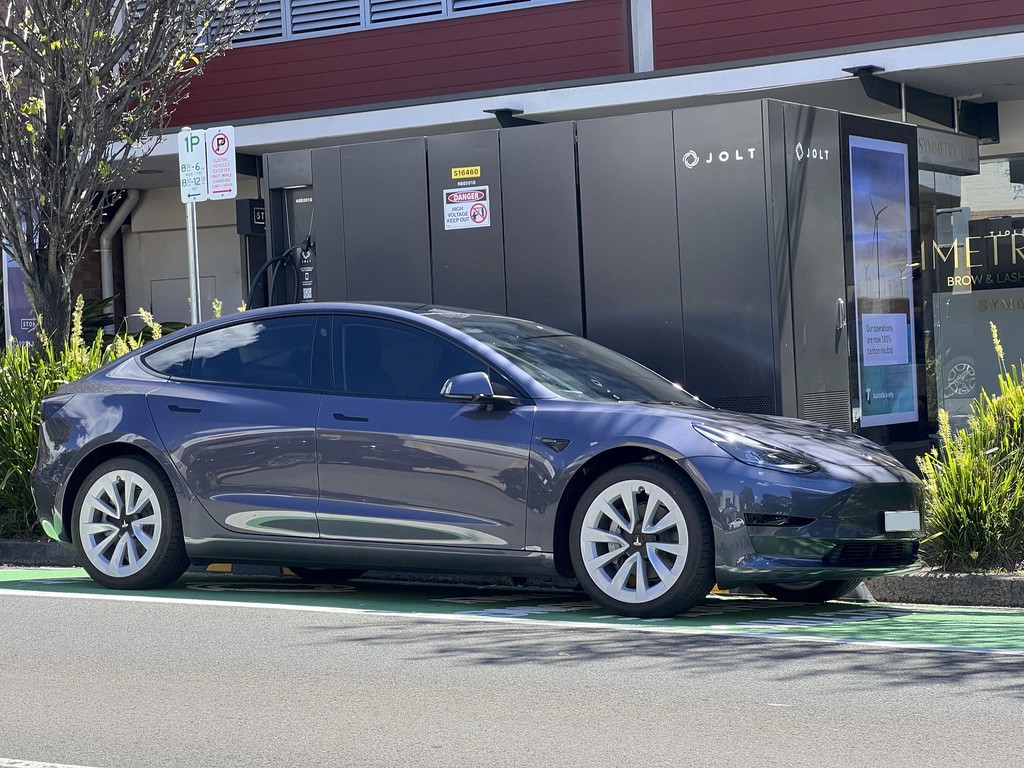
| JOLT | Ad-supported kerbside | 4 major cities (urban) | 25→50 kW | First 7 kWh/day free, then ~46c/kWh |
Also notable: Exploren (Intellihub-backed B2B platform / “network of networks,” absorbed ENGIE’s ~200 ANZ chargers in 2025) and Tritium — the Brisbane hardware maker whose collapse and gen-1 reliability problems are a live drag on network uptime.
05 / Home Charging & The Free-Window Revolution
The price war moved to the middle of the day
Retailers are giving away the midday “solar soak” — there’s now so much rooftop solar that wholesale prices routinely hit zero or go negative around noon. Free electricity has quietly become a customer-acquisition weapon.
Genuinely free (0c/kWh) home windows
| PLAN | FREE BLOCK | DAYS | STATES |
|---|---|---|---|
| OVO “Free 3” | 11am–2pm (3 hrs) | Daily | VIC, NSW, QLD, SA |
| Powershop “EV Day” | 12–2pm (2 hrs) | Daily | VIC, NSW, SA, SE QLD |
| Red Energy “Red EV Saver” | 12–2pm (2 hrs) | Weekends only | NSW, VIC, QLD, SA, ACT |
| GloBird “Free Lunch” |
12–2pm | Daily | verify directly |
| ActewAGL evEnergy | 12–2pm | Weekends | ACT |
| Solar Sharer Offer |
3 hrs, up to 24 kWh | Daily | NSW, SE QLD, SA (mandated) |
Near-free overnight windows (cheap, not free)
| Retailer | EV-window rate | When | Notes |
|---|---|---|---|
| OVO Energy | ~4.5c/kWh | Overnight (~12–6am) | Cheapest fixed EV window; multi-state |
| GloBird (EASYEV) | 6c/kWh | Overnight + 11am–2pm | Only dual night + “solar-soak” daytime window |
| Powershop EV Night | ~5c | overnight | companion to EV Day |
| EnergyAustralia | 7c/kWh | EV window | NSW only |
| AGL | 8c/kWh | Fixed EV window | Cross-promo: −6c/kWh at public bp pulse chargers (time-limited) |
| Origin (EV Power Up) | ~8c/kWh | App-scheduled | Smart-charges into solar/overnight price troughs automatically |
| Amber | Wholesale pass-through | Dynamic | Near-zero/negative on good days; SmartShift automation; V2G pilot leader |
| Red Energy / Engie | EV add-on / credit | Off-peak | Engie offers a $100 Chargefox sign-up credit |
THE SOLAR SHARER OFFER (SSO)
From 1 July 2026, every retailer in the relevant regions must offer at least one plan with a 3-hour free midday block (0c/kWh). It makes the free-window model — which Powershop, OVO and others pioneered voluntarily — government policy. EVs are an explicit target: the AER’s chair has said the regulator “would like to see EVs being charged in the middle of the day.”
- FREE HOURS NSW & QLD 11am–2pm · SA 12–3pm
- DAILY CAP Up to 24 kWh free
- WHERE FIRST NSW, SE QLD, SA · Vic separate · rest by 2027
- RULES Smart meter req'd · retailers must offer · opt-in
The honest catch: the free block is roughly cost-neutral for people who don’t shift load — retailers recover it through slightly higher rates outside the window. You only win by genuinely moving consumption into it. A 3-phase home charger can pull 20–30 kWh in those 3 hours, making an EV close to the ideal way to monetise it.
06 / The Free-Charging Question
Is free charging still happening?
Yes — but it has migrated. Free charging moved off the public network (where it’s nearly gone) and into the home midday window (where it’s expanding and now mandated).
| PUBLIC CHARGING TYPE | STILL FREE? |
|---|---|
| Highway DC fast | |
| Urban DC top-up | |
| AC destination | |
| AC council / kerbside | |
| Workplace |
The free → paid timeline
Early networks were grant- and demonstration-funded to seed adoption, then switched to user-pays once grants ended, queues appeared, and the cost of expanding and maintaining (read: reliability) had to be covered.
- 2015 RAC Electric Highway (WA) launches: free, as a decade-long demonstration project.
- Jun 2018 Queensland's Electric Super Highway ends free charging → ~45c/kWh.
- 2019–21 Chargefox ultra-rapid intercity network opens — paid from the outset.
- Sep 2023 NRMA switches its member-free fast chargers to paid (54–59c/kWh).
- Jun 2025 RAC Electric Highway wound up — a fitting bookend to the free-DC era.
-
2025–26
JOLT remains the lone free DC option (7 kWh/day).
Free "moves home" via midday windows + the Solar Sharer Offer.
Powershop “EV Day” gives 2 hours of free electricity, 12pm–2pm daily (VIC, NSW, SA, SE QLD; owned by Shell Energy Australia). That midday timing is the tell — it’s a solar-soak offer, not a traditional overnight tariff. A companion “EV Night” plan runs ~5c/kWh overnight for those who’d rather charge while they sleep.
07 / Where they actually compete
It’s about the customer, not the kilowatt
Because home charging dominates the energy, competition is concentrated here:
- Marginal, away-from-home kWh for road trips and top-ups. Here public networks have no real substitute, and the competition is between operators, not against the home.
- No-home-charging customer renters and apartment dwellers. This is the one segment where public/kerbside (powerpole) charging is a genuine primary substitute for home charging, and it's the fastest-growing. Nobody has fully cracked strata/kerbside/powerpole economics yet.
- Customer relationship and data is the deepest battleground. Fuel majors (Ampol, bp) and motoring clubs (Chargefox/NRMA) are using charging to retain the customer they're at risk of losing as petrol declines. Retailers are using EV tariffs + VPP + (soon) V2G to lock in the household. Convergence is the theme: Ampol now sells fuel-forecourt charging and home electricity (Ampol Energy has been acquired by AGL); AGL cross-promotes with bp pulse; motoring clubs straddle both sides via memberships and Chargefox.
08 / Forward Battlegrounds
What’s next
- "Solar soak" / smart daytime charging. With 4.3m solar homes and frequent near-zero midday wholesale prices, the next move is shifting charging *into the middle of the day*. Retailers (Amber, Origin's app-scheduling, GloBird's 11am–2pm window) are first movers — and AEMO's Draft 2026 ISP explicitly flags flexible EV charging as critical to grid stability.
- [Vehicle-to-grid (V2G)](/posts/every-car-park-should-be-a-power-plant/). Turning the EV into a home battery / grid asset would massively widen home charging's advantage. It's technically live in SA and Amber runs an ARENA-funded pilot (~1,000 customers, expanded May 2026), but mainstream commercial V2G is gated on standards (AS 5438), OEM warranty unlocks, and AEMC tariff rules — realistically ~2027 for limited availability, ~2030 for scale. Retailers, not charging networks, are positioned to capture this.
- The apartment/strata gap. Whoever solves shared/kerbside/powerpole charging economically (JOLT, destination charging, strata retrofits) reaches mainstream adoption.
- Fleet & depot charging. A distinct B2B contest: novated-lease EVs are booming (FleetPartners: 60% of new novated business in FY25 was EV), with charging split messily across depot, public charge-cards, and home-reimbursement.
Policy headwinds. Most state purchase subsidies have ended; the PHEV FBT exemption ended April 2025 and the BEV exemption stages down from ~2027, modestly cooling the demand tailwind.
09 / Outlook
The bottom line
Expect the structural cost advantage of home charging to persist and widen (solar + smart tariffs + eventual widespread V2G), keeping public networks firmly in the complement role: premium convenience for travel and a lifeline for the no-driveway segment, not a day-to-day substitute.
Public networks will consolidate (the weakest balance sheets and worst-reliability hardware shake out) and segment into highway / forecourt / kerbside / powerpole lanes.
The biggest value shift goes to retailers that orchestrate the home (tariff + solar + battery + VPP + V2G) — making the electricity retailer, more than the charging network, the likely long-term “owner” of the EV customer.
Sources: Electric Vehicle Council State of EVs & ownership surveys (2025–26); AEMO Draft 2026 ISP; DCCEEW / Minister for Energy releases, ABC News and SolarQuotes on the Solar Sharer Offer (Jan–Jun 2026); Powershop, OVO, AGL, Origin, EnergyAustralia, Amber, GloBird, Red Energy plan pages; Tesla, Chargefox, Evie, NRMA, bp pulse, Ampol, JOLT and Exploren network pages; Queensland Government, RAC WA announcements; Carloop / Zecar / WhySolar infrastructure & tariff comparisons (2025–26).
Caveats: public-charging and retail-plan pricing change frequently and vary by site, state, and membership; several networks publish rates app-only; V2G timelines depend on standards and OEM decisions still in flux.*