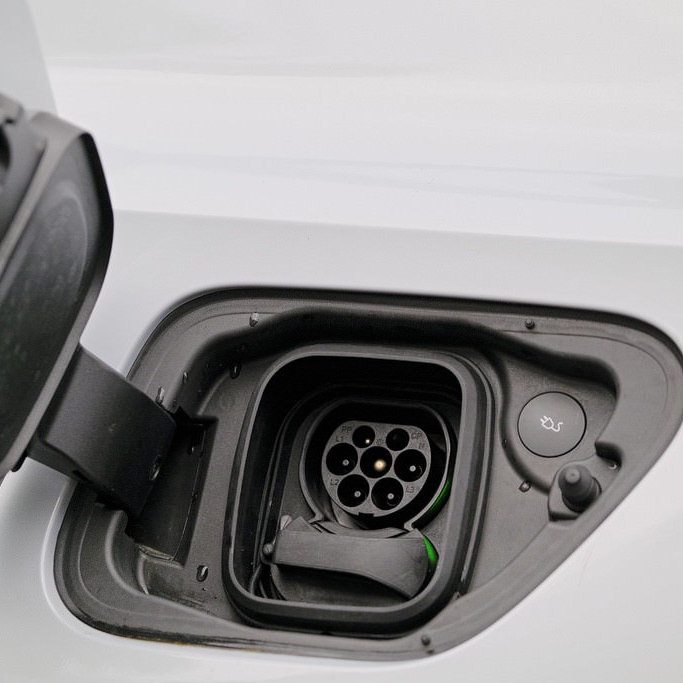
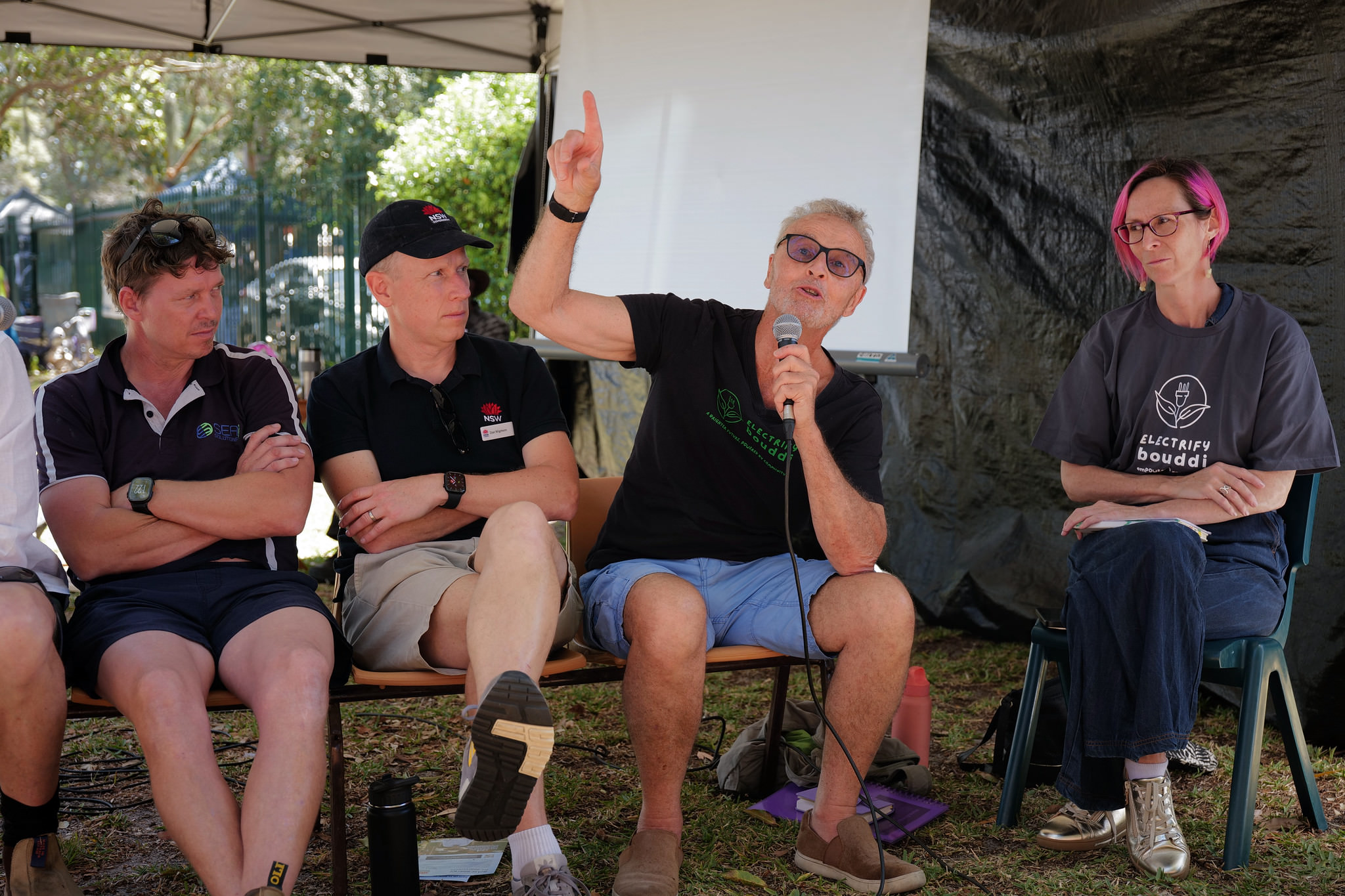
The panel at Woytopia in Woy Woy today was billed as electrifying your home, but the answers that matter most to EV owners were about charging: where NSW is putting fast chargers, whether you need a home charger at all, and how to use free midday electricity.
Who was on the panel
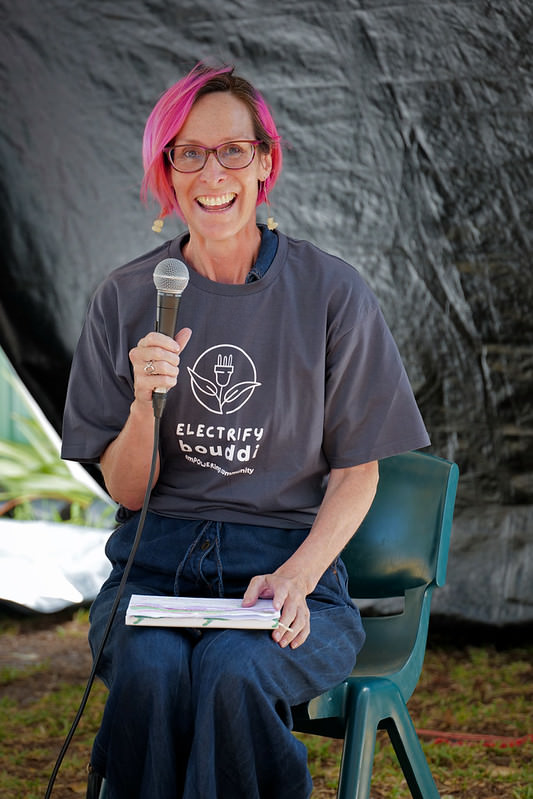
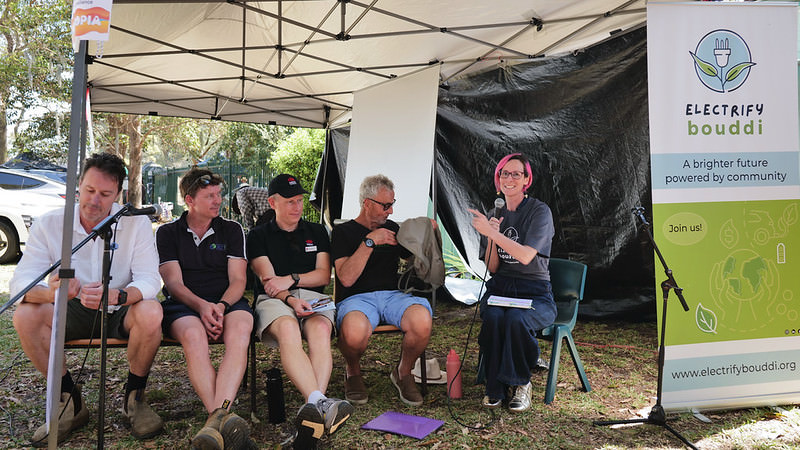
The session was run by Electrify Bouddi, a not-for-profit community group on the Central Coast, and hosted by Deb Potter. Questions came from the audience, and with only cabled microphones on stage, some were shouted.
- Mark Ellis, chair of Electrify Bouddi, who has consulted to the International Energy Agency on energy efficient appliance policy
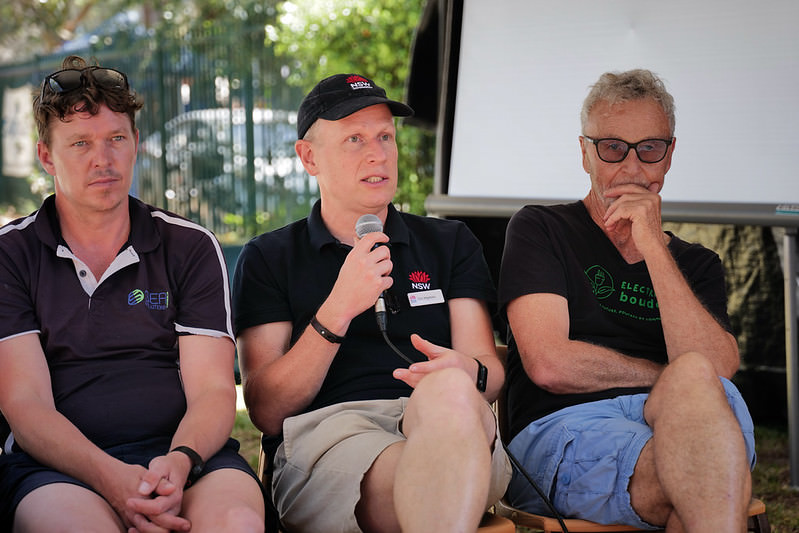
- Adam Corrigan, founder of Your Energy Friend, who says he has done more than 8,000 home energy audits
- Joe Harvey, a solar and battery installer (SEA Solutions) and one of Electrify Bouddi’s recommended providers
- Dan Wigmore, engagement officer for energy and transport electrification at the NSW Department of Climate Change, Energy, the Environment and Water
A good chunk of the audience already had rooftop solar. A few drove EVs, a few more were looking at them, and a few had hot water heat pumps.
Fast charging in NSW
Dan said NSW aims for every point on a major highway to be within 100 km of a fast charger, where fast means 20 to 80% in about 20 minutes. In the main Sydney commuter corridors the aim is within 5 km.
The state co-funds charge point operators rather than building the sites itself, and he named Tesla, Ampol and NRMA among them. Round four of the fast charging program is about to be announced, and its purpose is to fill black spots. One of those black spots is around here, though Dan was careful to say that does not guarantee a charger. Nearly a thousand sites have been funded across the program, covering destination, kerbside and fast charging.
He was also frank about why it is slow. Fast charger installs can take 18 months to two years, and a fast charging site can draw as much power as a small shopping centre. His summary: today is as bad as it is ever going to be.
On range worries, Dan has driven 25,000 to 30,000 km around NSW in his own EV, including Griffith, Byron Bay and Wagga. Broken Hill is the one he missed. He has owned an EV for four years and cannot charge at home. The host suggested PlugShare and A Better Routeplanner for checking chargers on a route (see EV essential mobile apps).
Charging at home
Asked what a home charger costs to install, Dan’s short answer was a couple of grand, depending mainly on the distance to the switchboard and the individual site.
He also admitted what many owners do: plug the car into a normal power point, tell themselves a proper charger will come later, and never buy one. Several panellists said they had done the same. Their reasoning was that trickle charging covers what they actually need.
The installer’s advice was to buy the charger and any home battery as a pair that can talk to each other. That lets the system prioritise loads, and hold the battery at a set percentage when grid prices make charging the car straight from the grid the better option.
Dan’s framing was to treat the car as an energy asset in the home, next to the aircon and hot water, even if it runs on petrol or diesel today. Transport is not yet the highest-emitting sector in NSW, but he said it will be within the next couple of years. For charger speeds and load management in more detail, see the Everything Electric 2026 panel.
EV batteries: lifespan and recycling
Dan expects an EV battery to outlast the rest of the car. He pointed to a recent study of Teslas that had done close to a million kilometres, which showed far less degradation than anyone expected, and put average degradation at 1 to 2% per year.
When a battery can no longer power a vehicle it can be removed and used for stationary storage. He has seen shipping containers full of old batteries powering industrial sites and hospitals. He also relayed what a battery recycler told him: 97 to 98% of the minerals can be recovered, from toothbrushes to trucks, depending on the chemistry. He was clear that recycling is not his area.
Mark added that a national stewardship scheme is being developed, and that the most likely outcome is an obligation on manufacturers to take batteries back as a last resort. The minerals are valuable, so he expects the economics to favour recycling. Both said this is years, if not decades, away from being a practical problem.
There is a smaller, nearer example: Mark said a pilot on the Central Coast now collects old solar panels for recycling, and about 90% of the material in a panel is recyclable.

Free midday power and shopping around
The Solar Sharer Offer began on 1 July. It is a regulated plan that gives three free hours of electricity, 11am to 2pm in NSW, up to 24 kWh a day. The panel’s warning was that rates outside that window are higher than most people pay now, so you end up worse off unless you move load into it. The people who can are those with an EV or a home battery. Mark said households with neither probably will not save money. The installer’s answer for them was a battery sized to charge during the three free hours and cover the rest of the day, which also suits a shaded roof.
Canstar’s worked example for an Ausgrid household shows how tight it is: shifting nothing costs $1.61 a day more than a cheaper time-of-use market plan, while shifting 5 kWh a day turns that into a saving of $0.57 a day.
To make 24 kWh concrete, the installer used power times time. A 4 kW ducted air conditioner running for four hours uses 16 kWh. The big loads are anything with a motor or an element: an electric hot water element, pool pumps and heaters, spas, air conditioners and EVs.
Adam’s simplest tip: enter your NMI from the front of your bill into Energy Made Easy, which compares a year of your meter data against every offer. He said there are about 17,000 (plan variants), and that one household he audited last week could save $2,500 a year just by switching. Wholesale prices have dropped by over 40% in the last 12 months and he said that is now flowing through to retail. He pays 24 cents a kWh, the best rate he has found in about a decade. A year and a half ago, nothing was under 30 cents.
He changes retailer every summer onto a flat 24 cent rate so he can run the aircon in the middle of the day, and goes back to a time-based plan for winter. He said it takes about ten minutes.
Hot water, gas and the rest of the house
The most detailed audience question was heat pump versus solar hot water. The panel explained a heat pump as a fridge run in reverse: it pulls heat from the air into the tank. A solar hot water system heats the water directly on the roof. Hot water is normally 30 to 40% of a home’s energy use, and a panellist said hot water and heating and cooling are the two biggest users in a house.
- A good quality heat pump costs about three to four grand after rebates. The advice was that you get what you pay for.
- One panellist paid seven grand for a solar hot water system, has not connected it to the grid in 18 months and has had no hot water problems with two teenagers.
- If you are replacing an existing electric or gas tank, a heat pump is the easy swap, because the plumbing and slab are already there. Solar hot water needs plumbing and electrics up to the roof, and the roof space.
- Another route is a standard tank plus enough rooftop solar to cover its use.
Mark’s cheapest tip was a timer. Many households still heat water overnight or early in the morning. Moving it to the middle of the day, which any electrician can do, means using largely solar-generated energy even if you have no panels. Heating at off-peak hours overnight, he said, just keeps coal-fired power stations going.
On gas, the advice was blunt: get off it. Gas prices are rising now that it is exported, and hot water is typically the biggest energy use in the house. For people mid-renovation, one panellist said the regulator limits what the gas network can charge for a disconnection to about $500 against an actual cost of a couple of grand, and asked not to be quoted on the figure. Mark thought there is also a subsidy.
On a 15-year-old six-panel solar system, the installer’s advice was not to spend money on it. Add a new system alongside it, or replace it if it is close to failing. Panels have gone from 150 W when he started installing to 475 W now, with little change in physical size.
Paying for it
Dan pointed people to the NSW Home Energy Saver program: a zero-interest loan of up to $15,000, repayable over up to 10 years, for upgrades he listed as solar, batteries, heat pumps, EV chargers, insulation and draught-proofing. The program page says loans are open to owners and landlords with a combined household income of up to $210,000. A discount of up to $4,000, for households on up to $80,000 or with a concession card, is listed as coming soon, and renters will need their landlord’s approval.
Adam’s order of attack for any home, from the thousands he has audited:
- Understand your bills.
- Shop around for a retailer.
- Draught-proof and insulate. He said that with a 30 km/h breeze outside, the air in a typical Australian home is exchanged 19 times an hour (his figure), and that a 5% gap in an insulation blanket halves its effectiveness.
- Then look at solar, which costs more.
His last point was for anyone with a mortgage. He said there is a federally funded discount on the interest rate, of half to three quarters of a percentage point, based on the energy efficiency rating of the home. Banks set different criteria. Some want a star rating from an assessor like him, others simply want no gas, solar and a heat pump hot water system. He said the households he has helped save $30,000 to $40,000 over the life of the loan, but that many mortgage brokers avoid these loans because the commission is about half, and he has found only two specialist brokers in the state. Check the details with your bank before relying on any of this.
Dan’s closing point was for EV sceptics. He has owned an EV for four years without a home charger, and his line was that if he can do it, anyone can.
Sources
- Home Energy Saver, NSW Climate and Energy Action
- What is the Solar Sharer Offer?, Canstar